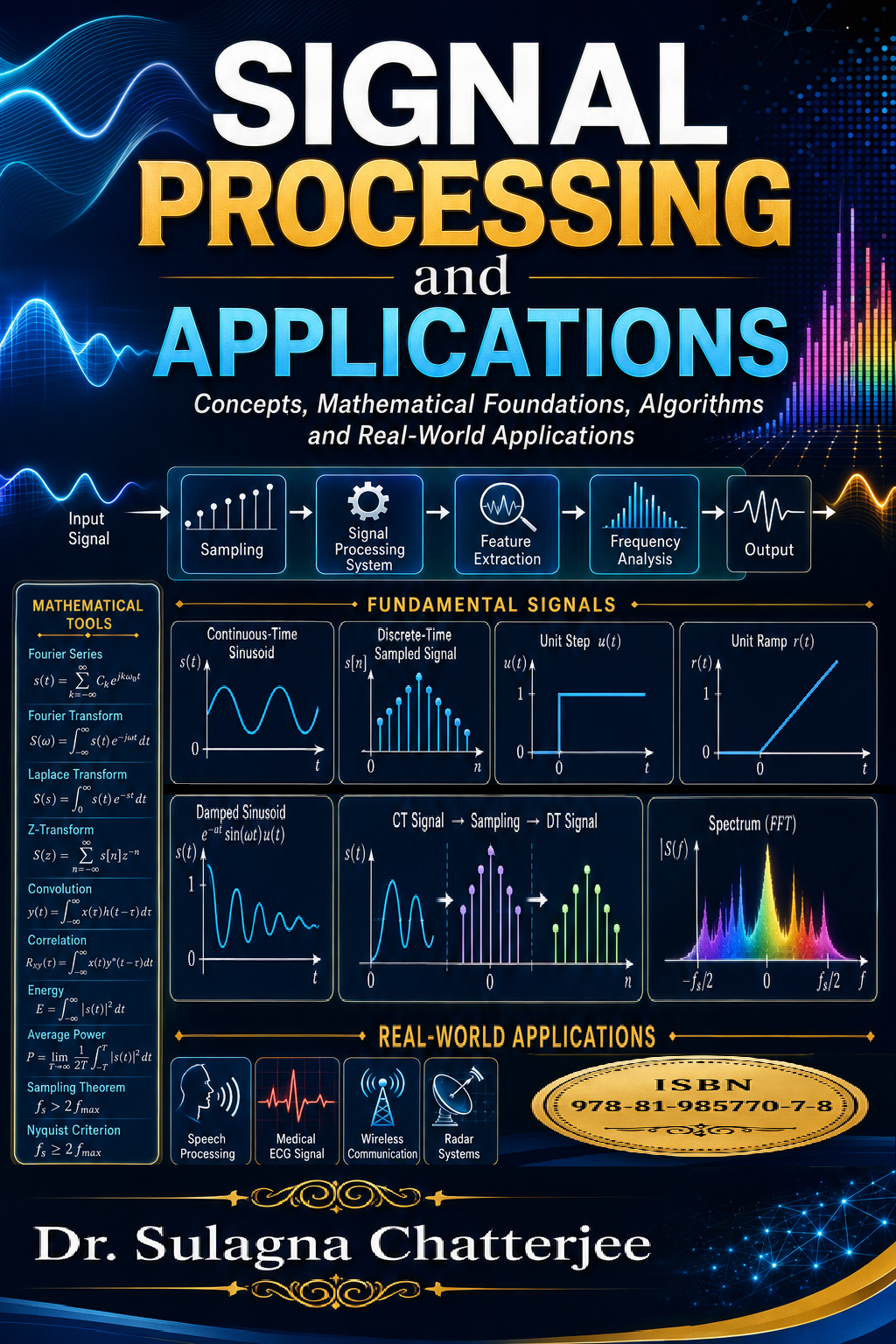
Signal Processing and Applications
A Book of Concepts, Mathematical Functions, Algorithms and Real-World Applications
Published: 31 July 2026
ISBN: 978-81-985770-7-8
Price: ₹249
List of Chapters
This Chapter introduces the rudimentary concepts of signals and systems in analog as well as discrete domains. In this Chapter, signals have been defined as data functions that convey information. Subsequently, systems have been defined as operators that operate on such data as are carried by signals.
The Chapter fundamentally classifies such signals depending on their inherent properties namely time: periodic & aperiodic; quantitative traits: energy & power; probability: deterministic & random; causality: causal, anti-causal & non-causal.
Basic signals that lay the foundation of signal processing such as the unit impulse signal, unit step signal, sinusoidal signals, exponential signals, ramp signal, parabolic signal etc. have been described with emphasis on the inter-relation amongst them.
Similar to the classification of signals, types of systems have also been likewise categorized. Summarily, this Chapter provides the groundwork that is necessary for comprehending and analyzing various engineering applications in the field of signals and systems.
Chapter 2 establishes a strong foundation for Linear Time-Invariant (LTI) systems; since LTI systems are elementary components of signal processing.
This Chapter explains through qualitative analysis and quantitative examples that an arbitrary signal may be decomposed into a simple combination of unit impulses.
The Chapter proceeds to explain System Characterization through Convolution i.e. the characterization of an LTI system by using the impulse responses of the concerned system combined with suitable mathematical operations namely convolution integral in continuous time domain and convolution sum in discrete time domain.
The Chapter emphasizes on Signal Representation by Impulses, calculation of output signals by convolution and evaluation of fundamental algebraic attributes of the system such as Commutative property, Associative property and Distributive property.
Physical Constraints and System Behaviours have been focussed upon namely Memory, Channel Equalization & System Invertibility, Causality criteria & Accumulator, Conditions of Stability and the Unit Step Responses & their significance.
Details of Time-Domain Modelling have been mathematically stated and explained for causal systems, using linear differential equations in continuous time domain or linear difference equations in discrete time domain, both having constant-coefficients, under the conditions of initial rest.
Block diagram implementations for visualizing such systems have also been treated with care.
Chapter 3 introduces the z-transform that is a key mathematical tool for analyzing discrete-time systems in signal processing.
The Chapter explains the significance of the Region of Convergence (ROC) using polar coordinates.
The concept of inverse z-transform & recovery of original signals; transform pairs for both causal & anticausal signals, finite & infinite bilateral signals; rational transforms & location of poles and zeros in the complex plane for assessing system stability have been covered.
The inter-relations between z-transform & Fourier Transform (DTFT); and z-transform & Laplace Transform have also been carefully treated.
This Chapter describes the Properties of Z-Transforms i.e. the fundamental mathematical rules that determine the operational properties of z-transforms namely, linearity, time shift, complex domain scaling, time reversal, differentiation, convolution, correlation, autocorrelation and multiplication.
Finally, Parseval's relation and the Initial-Value Theorem (IVT) have been explained.
The Chapter lays the foundation for assessing the Stability Criteria depending on the causality state of the system and the location of poles in the complex plane.
The Chapter further outlines the core methods for verifying System Stability.
This chapter also includes a foundational reference set of elemental z-Transform Pairs that are widely used in signal processing applications.
About the Author
Dr. Sulagna Chatterjee is an accomplished educator and researcher, currently serving as the Head of the Department of Electronics at Abhedananda Mahavidyalaya. With 15 years of teaching and research experience, her expertise spans Semiconductor Device Physics, Nanotechnology, and Quantum Physics.
She completed her Ph.D. (Tech.) in Nano Science and Nano Technology from the University of Calcutta in 2019. She has received prestigious fellowships including CSIR-SRF, DST INSPIRE, and IIT Institute Fellowship. She has also been awarded a Gold Medal and the PDBB Award for Outstanding Academic Excellence for securing First Class First in her M.Tech.
She has published 15 SCI-indexed international journal papers as first author, along with several co-authored papers and book chapters. She has delivered invited talks at reputed national and international conferences and has received several awards, including the Young Achiever Award, Best Teacher and Research Excellence Awards, and the Elsevier Reviewer Excellence Award.
Publication Rights Reserved
Applied Computer Technology
Kolkata, West Bengal, India
Email: info@actsoft.org Mobile: +91-6291839750 | Website: www.actsoft.org